Home / Estimating
Estimating a construction job in minutes, not weeks
A measured take-off and price is days of a quantity surveyor's time, which is why small firms price by instinct and large ones price late. It does not have to be either. Paste a Bill of Quantities, upload a drawing, or send a few photographs, and get a costed band back with the source of every rate shown — so you can see immediately which numbers are firm and which need a supplier quote.
What estimating actually involves
Two separate jobs get bundled under one word, and confusing them is where most estimating goes wrong.
Taking off is measurement: reading the drawings and working out how much of everything there is. Ninety metres of 110mm foul drain, two hundred and forty square metres of sub-base, six manholes. It is arithmetic and it is unforgiving — a quantity error carries straight through to the price and nothing downstream will catch it.
Pricing is applying a rate to each measured quantity. This is where judgement lives, because a rate is not a single fact. It depends on what is included, where the site is, how big the order is, and when it is being bought.
What sits inside a rate
A supply-only rate is the material delivered to site and nothing else — a tonne of Type 1 tipped at the gate. A composite supply-and-fix rate covers the material, the labour and everything the operation drags with it: for a drain run, the trench excavation, the bedding, the pipe surround and the backfill, not just the pipe.
Pricing a delivered tonne as though it were laid is a classic way to lose a job you have already won. Our rate card keeps the two apart deliberately and the pricer tells you which basis each line used.
Three ways in
Paste a Bill of Quantities
Paste the bill straight in — reference, description, quantity, unit. Every line is matched against the rate card and returned with a low, most-likely and high figure, the basis it used, and a clear flag on anything it could not price. Export the priced workbook as CSV.
Open the BOQ pricer →Upload a drawing
Send a DXF or PDF drawing and the quantities are taken off it before pricing. This is the most accurate route because the measurement comes from the drawing rather than from a description of it.
Upload a drawing →Send photographs
Plenty of real work has no drawings at all. Photograph the site or the area to be worked on, and a scope is built and priced from what is visible. Wider band, far better than guessing.
Estimate from photos →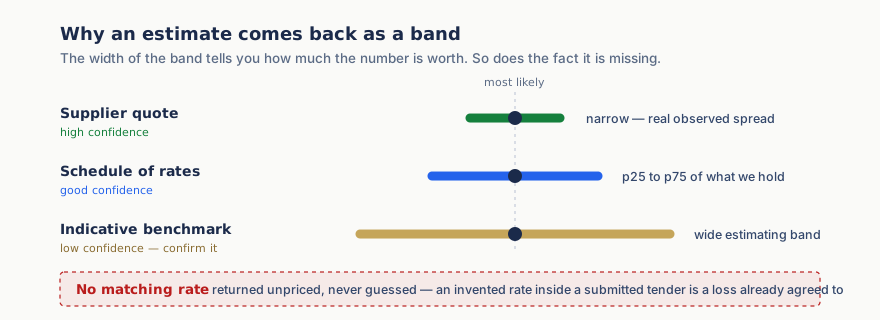
Why the band matters more than the number
An estimate returned as one confident figure is telling you something it does not know. Material prices move, sites differ, and a rate held for a national average is not a quotation for your job in your postcode this month.
So the pricer returns three numbers. Where several real observations exist for an element, the low and high are the actual spread of those observations. Where only a single benchmark is held, it applies an estimating band around it. Either way you can see how much room there is, which is the thing you actually need when deciding whether a job is worth bidding.
Unpriced lines are a feature
When nothing in the card matches an item, the tool says so and prices it at zero rather than guessing. That looks worse on a summary and it is the right behaviour: an invented rate on a submitted tender is a loss you have contractually agreed to. An unpriced line is a question you still have time to answer.
What to do with the estimate
- Decide whether to bid at all. This is the highest-value use. Most tenders are not worth your week, and finding that out in two minutes rather than two days is the whole point — see winning UK construction tenders.
- Firm up the weak lines. Take the indicative and unpriced items to real suppliers. Materials and procurement covers matching a requirement to verified suppliers.
- Sense-check a subcontractor's price. A quote that lands well under a benchmark band is not automatically a bargain, and one well above it is worth a conversation before you accept.
- Turn it into a client-ready document. Export the priced workbook — reference, item, quantity, unit, rate basis, low/mid/high and totals — and print or send it.
Questions
What is a Bill of Quantities?
A line-by-line schedule of the measured work in a job — each item, the quantity, and the unit it is measured in. It lets several contractors price identical scope, which is why public and commercial tenders are usually issued with one.
How accurate is an instant estimate?
Accurate enough to decide with, not accurate enough to sign with. It returns a low, most-likely and high band rather than a single figure, and labels each line with where its rate came from. Confirm with supplier quotes before any tender submission or contract.
What does a composite rate include?
A supply-and-fix rate covers material, labour and the associated work — for a drain run, the excavation, bedding, surround and backfill as well as the pipe itself. A supply-only rate is the material delivered and nothing else. Conflating the two is one of the commonest estimating errors.
Can you estimate without drawings?
Yes. Photographs of the site or the area to be worked on are enough to build a scope and price it. It is less precise than a measured take-off, and the band widens accordingly, but it is far better than a guess.
Why do some lines come back unpriced?
Because there is no matching rate held for that item. The tool says so rather than inventing a figure — an unpriced line is an honest gap that needs a supplier quote, and a made-up rate on a tender is how firms lose money on work they win.
Is the estimate a fixed price?
No. Estimates are indicative. Any works or supply we carry out are confirmed by written quote first.
Send us the job and we will price it
Drawings, a bill, or a description of what needs doing. You get a measured, costed estimate back — checked by a person before it reaches you.
Price something now
Paste a bill and see what comes back. It is free, needs no account, and it will tell you honestly which lines it could not price.