Home / Tenders
Winning UK public construction tenders
UK public bodies publish every construction contract they buy, as open data, for free. Most builders never see the ones they could win — not because they can't do the work, but because the notice was never in front of them while there was still time to price it. This page explains where the notices come from, how to filter them down to work you can actually win, and how to check who has won that kind of contract before.
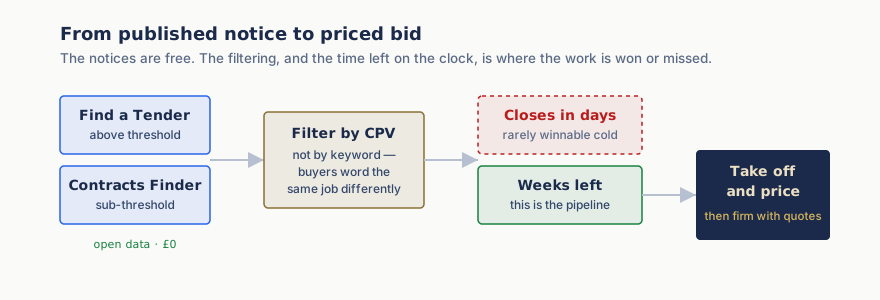
Where the notices actually come from
There are two official UK sources, and between them they carry effectively all public construction work.
Find a Tender Service carries contracts at or above the procurement thresholds — the larger frameworks, the multi-year maintenance contracts, the major civils schemes. Contracts Finder carries lower-value opportunities and most sub-threshold public work: a school roof, a car park resurface, a housing association's drainage programme.
Both publish as open data in OCDS format. That matters more than it sounds. It means the notices are machine-readable and free — so any tool that charges you a monthly fee for "tender alerts" is charging you for filtering, not for access. There is nothing behind a paywall that you cannot read yourself.
Why most firms miss the work they could win
They find out too late
Sorting by deadline is revealing the first time you do it. A meaningful share of what is "open" at any moment closes within days. Those are not real opportunities for a firm that has not already been tracking them — you cannot take off quantities, price the materials and write a method statement in forty-eight hours while running live jobs.
The winnable notices are the ones with weeks left. Seeing those requires looking regularly, not looking when work goes quiet.
They search by keyword instead of category
Keyword search on tender portals is unreliable, because buyers describe the same work in wildly different language. "Tree work", "arboricultural services", "highway tree maintenance" and "grounds maintenance" can all be the same contract type. Category codes are the fix — every notice carries a CPV code classifying what is being bought, and filtering on the code catches the contracts that a word search walks straight past.
They never look at who won last time
Award notices are published too, not just invitations. That means the history of who has won each category of contract, from which buyer, at what value, is a matter of public record. It is the most underused free intelligence in UK construction: before bidding, you can see who you are bidding against, whether the buyer keeps returning to the same supplier, and what the work actually went for.
What we run on this
These are working tools on live public data, not descriptions of a service. They are free and need no account.
Open tenders, by trade
Every open UK construction and trade contract from both official sources, filtered to construction and sorted soonest-deadline-first, with buyer, value and days remaining. Filter to roofing, refurb and fit-out, civils and groundworks, housing and maintenance, M&E or demolition.
Open the feed →The bigger contracts
Find a Tender carries the above-threshold work that Contracts Finder does not — larger frameworks and long-run maintenance contracts. Both feed the same view, so the big-ticket notices sit alongside the local ones rather than in a separate system.
Open the feed →Who wins this category
Awarded contracts by category and buyer — who bought, who won, at what value. Useful before you commit days to a bid, and useful for knowing which buyers actually rotate their suppliers.
Ask about award history →Matched to proven bidders
Every live tender joined to the firms that have won that exact category before. For a main contractor it shows the natural subcontract pool; for a specialist it shows where the work it already does is going out to bid.
Open the feed →From notice to priced bid
Finding the tender is the easy half. The reason firms skip winnable work is usually that pricing it properly costs days they cannot spare.
- Take off and price the bill. Paste a Bill of Quantities into the BOQ pricer and get a low/mid/high back with the provenance shown per line, so you can see which rates are firm and which need a supplier quote before you commit.
- Firm up the materials. Match what the job needs against a verified supplier network and get real quotes rather than guessing — see materials and procurement.
- Check who you are engaging. If you are packaging work out, run the subcontractors past a solvency check first. A subbie failing mid-contract on public work is a category of pain worth avoiding.
Questions
Where do UK public construction tenders get published?
Two official places. Find a Tender Service carries contracts at or above the procurement thresholds. Contracts Finder carries lower-value opportunities and most sub-threshold public work. Both publish as open data in OCDS format, so neither needs a paid subscription to read.
Do I have to pay for a tender alert service?
No. The underlying notices are free public data. Paid portals repackage the same feeds and add filtering on top. Our live tender feed is free and needs no account — you are welcome to use it and nothing is gated behind a signup.
What is a CPV code and why does it matter?
A Common Procurement Vocabulary code classifies what a contract is for. It matters because it is the most reliable way to find work you can actually do — buyers describe the same job in very different words, but the code stays consistent. It is also how you see which firms have won that same category before.
How far ahead should I be looking?
Longer than most firms do. A notice closing in three days is rarely winnable from a standing start. Sorting by soonest deadline shows what is about to be lost; the value is in catching the ones with weeks left, while there is still time to take off quantities and get supplier quotes back.
Can a small firm win public work?
Yes, and sub-threshold contracts on Contracts Finder are usually where it starts. The barrier is rarely capability — it is that smaller firms never see the notice, or see it too late to price it. That is a visibility problem, and it is solvable for nothing.
Want us to watch a category for you?
Tell us the trade and the region and we will come back with what is open in it — and flag the ones worth pricing rather than every notice that mentions your keyword.
See what is open right now
The live feed is free, needs no account, and reads the same official sources the paid portals do. Filter it to your trade and see what closes when.