Home / Subcontractors
Check the subcontractor before you commit the package
Construction carries more insolvencies than any other UK sector, and a trade failing part-way through a package is not a billing problem — it is a programme problem, a rework problem and sometimes a retention you never see again. Almost everything you need to spot the risk is public and free. This page covers what to look at, which signals actually matter, and where CIS fits.
What the public record actually tells you
Two free sources carry nearly all of it, and between them they answer the questions that matter before you hand over a package.
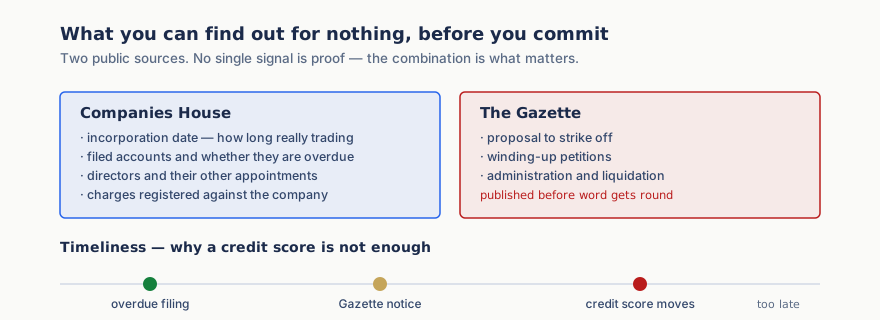
Companies House gives you incorporation date, registered office, directors and their other appointments, filed accounts, and any charges registered against the company. The Gazette is the official public record of insolvency: winding-up petitions, administration, liquidation and strike-off notices are published there before most people hear about them.
Put together, those tell you how long the firm has really traded, whether it keeps its filings current, whether it is secured against, and whether formal proceedings have begun. That is a serious amount to know for nothing.
The signals worth acting on
Overdue filings
Accounts or a confirmation statement past their due date is the single most useful free signal in UK company data. It is rarely defiance — it is usually a firm with no bandwidth, no bookkeeper, or nothing good to file. It is also timely in a way that a credit score is not.
Proposal to strike off
A first Gazette notice proposing dissolution should stop a package outright until explained. Sometimes it is an administrative lapse being corrected. Sometimes it is the visible end of something that started months earlier.
A very new company on a large package
New companies are not a problem in themselves — everyone starts somewhere, and plenty of good trades incorporate fresh after a partnership splits. It becomes a problem when the package value is large relative to any trading history, because there is no track record to price the risk against.
Churn in the registered details
Repeated changes of registered office or director inside a short window is worth a question. Individually meaningless; in a cluster, it tends to mean something is being reorganised.
What we run on this
Subcontractor solvency check
Enter a Companies House number and get incorporation age, SIC codes, registered office, filed accounts and distress signals back. Works on any UK company — suppliers and clients as well as trades.
Check a company →CIS handling
Subcontractor verification with HMRC, deduction at the rate returned, and the monthly CIS300 return. The scheme is unforgiving about verification — deducting at the wrong rate is the contractor's problem, not the subcontractor's.
Talk to us about CIS →Package it properly
If you are pricing a tender you intend to package out, check the trades while you are still pricing rather than after you have won. It is the cheapest moment to find out.
Winning tenders →Where CIS fits
The Construction Industry Scheme governs how contractors pay subcontractors. Three obligations do the work: verify each subcontractor with HMRC before paying them, deduct at whatever rate HMRC returns — gross, standard or higher — and file a monthly CIS300 return declaring the payments and deductions.
The part that catches people is verification. Assuming a rate, or carrying last year's status forward, means deducting the wrong amount, and the liability sits with the contractor. Verification is also where the solvency check and the compliance step overlap: if you are already looking a firm up before engaging it, doing both in the same pass costs nothing extra.
Questions
What can I actually find out about a subcontractor for free?
More than most people expect. Companies House publishes incorporation date, registered office, directors, filed accounts and charges. The Gazette publishes insolvency and strike-off notices. Together that covers how long they have traded, whether filings are current, whether the company is secured against, and whether formal proceedings have started.
Which warning signs matter most?
Overdue filings, a proposal to strike off, recent insolvency notices, a very recent incorporation on a large package, and repeated changes of registered office or director. None is proof on its own; two or three together justify a conversation before you commit.
Is a credit score enough?
No. A score summarises history and it lags reality — most construction insolvencies are cash-flow failures that develop faster than a score updates. Filing behaviour and Gazette notices are more timely.
What is CIS and when does it apply?
The Construction Industry Scheme governs how contractors handle payments to subcontractors: verifying each one with HMRC, deducting at the rate returned, and filing a monthly CIS300. It applies to most construction operations, and getting verification wrong means deducting at the wrong rate.
Does checking a subcontractor mean I do not need a contract?
No. A check tells you who you are dealing with; it does not set out what happens when something goes wrong. Written scope, payment terms, retention and a programme still matter — the check tells you how much you should care about the terms.
Can I check suppliers and clients the same way?
Yes. It is the same public record. Checking who is going to pay you is at least as valuable as checking who is going to build for you.
Packaging work out?
Tell us what you are letting and we will check the trades with you — solvency, filings and CIS status — before anything is committed.
Check one now
Company number in, public record out. Free, no account, and it works on suppliers and clients as well as trades.